Nanomaterials:
A giant leap for healthcare
Nanoparticles may be tiny and invisible, but they’re making a huge impact in healthcare! "Nanomaterials: A giant leap for healthcare" is one of the thirteen selected flagship exhibits of the Royal Society Summer Science Exhibition 2026. Join us for an exciting experience and discover how these remarkable materials are revolutionising diagnosis, imaging, and treatment.
Tiny materials,
massive impact on healthcare


What you will see
Discover the fascinating world of nanoparticles at our exhibit! Explore how nanoparticles generate the characteristic coloured lines seen in diagnostic tools such as the lateral flow tests used for Covid, operate a portable flow reactor, and view cancer fighting nanoparticles through an infrared camera to reveal how our research is helping address real-world healthcare challenges.




Lateral Flow Technology
You may have used a lateral flow test during the COVID-19 pandemic, or perhaps a pregnancy test. But did you know that the same technology could one day save your life by detecting cancer at its earliest — and most treatable — stage? Lateral flow tests work thanks to the remarkable optical properties of gold nanoparticles, a phenomenon first discovered by Michael Faraday, whose original samples will be on display at our stand. However, current tests are not sensitive enough to detect the tiny amounts of cancer signature molecules present in the early stages of the disease.
At our exhibit, discover how we use simple chemistry to concentrate gold nanoparticles at the test line, making lateral flow tests more sensitive and play our interactive game "Red Line" to find out why!


3D Tumour Models
Animal testing has long been the standard way to evaluate new cancer treatments, but what if we could replace it with something more accurate, more ethical, and more relevant to human biology?
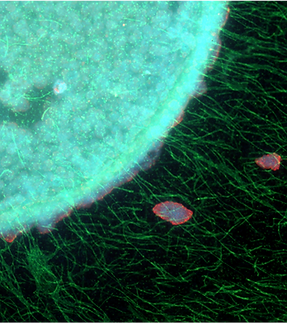
At our exhibit, meet the tumouroid: a miniature, three-dimensional model of a real tumour growing inside healthy tissue, built entirely in the laboratory using human cells. These remarkable constructs allow us to test whether new nanoparticle-based therapies can target and destroy cancer cells while sparing the healthy tissue around them.
Come and discover how we grow these living models and use them to understand how the cancer treatments of tomorrow might work, bringing us one step closer to more effective and personalised cancer therapies!
Portable Flow Reactor
One of the most effective ways to make nanoparticles is a lot like cooking: mix the ingredients, heat them up, and wait until the product is ready. However, nanoparticle "cooking" is far more demanding than your average casserole — the mixing and heating must happen with extraordinary speed and precision to produce high-quality materials suitable for healthcare applications.
To meet this challenge, we developed specialised devices called continuous flow reactors, which enable the efficient, large-scale production of nanoparticles without compromising their quality. One of our reactors, designed on a computer and built with a 3D printer, will be on display and running live at our stand, producing iron oxide nanoparticles in real time. Come and see it in action and discover how the nanoparticles it produces can be used to detect and treat cancer!

Magnetic Heat Therapy
Magnetic hyperthermia treatment using alternating magnetic fields to cause magnetic nanoparticles to heat and kill cancer cells, has the potential to be an effective cancer therapy with minimal toxicity on normal cells. It could be used as an adjunct to conventional treatments such as radiation therapy and chemotherapy. Currently, FDA-approved iron oxide nanoparticles are materials of choice, however, there are shortcomings of commercial particles which exhibit suboptimal heating efficiency, leading to low therapeutic efficacy and the need for higher doses. We have developed a simple, reproducible method to produce iron oxide nanoparticles that we call iron oxide nanoflowers, due to their unique appearance, for use in magnetic hyperthermia treatment for cancer. Our nanoflowers have at least 500 times higher heating efficiency compared to that of iron oxided nanoparticles used in clinical trials. Higher heating efficiency means lower dosing requirements and amount needed to achieve a therapeutic effect, which in turn could reduce the side effects and greatly facilitate adoption of this new therapeutic modality.
Michael Fadaray's gold nanoparticles
At our exhibit, you will see Michael Faraday’s original liquid samples and notebook, kindly loaned by the Royal Institution (Ri), together with the original peer-reviewed paper by Faraday on his experimental work on gold. The liquid samples are some of the first examples of gold colloids. They were made accidentally when Faraday was making sheets of gold leaf thin enough to mount onto microscope slides, by chemically washing particle layers of gold away. Faraday noticed the chemical fluid became a faint ruby colour, decanted it into a glass bottle, and shone a beam of light through it. Faraday observed that the light formed a cone, defined by gold particles suspended in the fluid, which although too small to see, nevertheless scattered the light. This is known as the Faraday-Tyndall effect, and because of this discovery Faraday is seen as one of the first researchers into nanoscience. Fourteen bottles of colloids held at the Ri are still optically active, after 170 years they were produced by the English scientist.



Our diverse, multidisciplinary team brings together academics, early career researchers and PhD students with expertise in nanomaterials, bioengineering, chemical engineering, tissue engineering, manufacturing of advance materials, pharmaceutics, diagnostics and physical chemistry.
Meet the Team

Prof Nguyễn T.K. Thanh
Professor Nguyễn Thị Kim Thanh, MAE, FRSC, FInstP, FAPS, FIMMM FRSB held a prestigious Royal Society University Research Fellowship (2005-2014). In 2019, she has been honoured for her achievements in the field of nanomaterials, and was awarded highly prestigious Royal Society Rosalind Franklin Medal. She was RSC Interdisciplinary Prize winner in 2022. She was awarded SCI/RSC Colloids Groups 2023 Graham Prize Lectureship to recognise an outstanding mid-career researcher in colloid and interface science. She is one of only 12 recipients globally of 2023 Distinguished Women in Chemistry/Chemical Engineering Awards, bestowed by the International Union of Pure and Applied Chemistry (IUPAC). She was elected as a member of Academia Europaean in April 2024.


Dr Guido Bolognesi
Dr Bolognesi is an Associate Professor in Physical Chemistry. His research focuses on transport processes and interfacial phenomena in soft matter and biological systems, with the aim of developing new technologies for biosensing, synthetic biology, therapeutics and drug delivery. His group takes an interdisciplinary approach, combining fluid mechanics, microfluidics, optics, and interface and colloid science. He has received multiple research grants from UKRI, the Royal Society, and the European Innovation Council. His group has developed novel strategies to manipulate nanoparticles in confined environments by harnessing chemical energy in saline solutions, with applications in nanoparticle separation, characterisation, and lateral flow diagnostics.

School visits
Visiting school groups will be able to explore the Royal Society Summer Science Exhibition between 30 June – 3 July, alongside the visiting public.
During their visit, school groups will have the opportunity to talk directly with a wide range of researchers at the 13 flagship stands as well as the opportunity to engage with a wide variety of publicly accessible interactive activities and talks.
Contact exhibitions@royalsociety.org for further details.
The exhibit is sponsored by